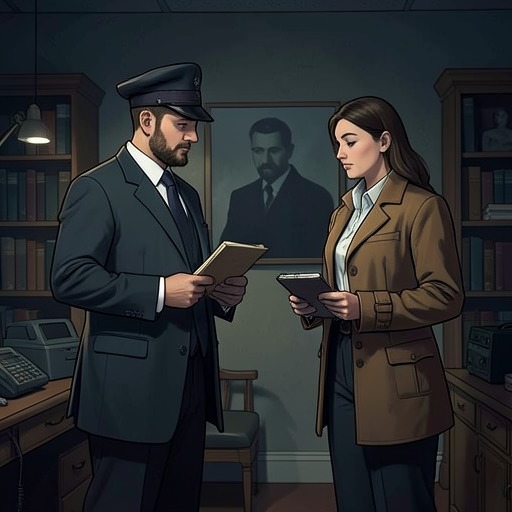
Tadao Asai
The Final CurtainTadao Asai is Hiromi Asai’s mild-mannered father, a small-shop owner whose tenderness and inability to protect his family from financial ruin shape both their lives. After his wife, Atsuko Asai, abandons them and leaves debts in her wake, Tadao tries to save Hiromi by faking his death and disappearing. His long flight, sustained by assumed names and concealment, ultimately becomes a burden he can no longer bear; his final message helps connect his family’s hidden past to Kyoichiro Kaga’s search for his mother, Yuriko.
Identity and Family Background
Tadao inherited responsibility for his family’s shop after his father was killed in the war. He had begun helping his mother with the business as a child and eventually took it over, but his commitment could not compensate for his lack of commercial toughness. Hiromi recognized that he was too soft to run the store: he could not refuse customers who bargained down prices, leaving already thin profit margins thinner still. His kindness is therefore both a personal quality and a practical vulnerability, making him ill-equipped to withstand the financial pressures that would engulf the household.
His marriage to Atsuko was already a source of resentment for her. She complained that a matchmaker had misled her about Tadao’s income and the family’s property, and that the shop sold cheap goods to poor customers. Hiromi remembered her mother at the vanity, using makeup taken from the shop shelves while complaining; the image became a lasting imprint of the bitterness in the home. Tadao, by contrast, is presented through his quiet devotion to his daughter and his reluctance to criticize his wife, even as her conduct grows increasingly disruptive.
The Family Breaks Apart
Atsuko had managed to act as a good mother during Hiromi’s elementary-school years, sometimes helping at the shop, and Hiromi loved her. After Hiromi entered junior high, however, Atsuko began going out frequently, returning late and often drunk. Tadao delayed confronting her for months. He finally objected when he noticed that Hiromi’s school uniform had not been properly washed, but Atsuko dismissed his concern and told him to do the laundry himself. Their quarrel exposed how far the household had deteriorated and how little protection Hiromi could expect from the adults around her.
Atsuko eventually went out one evening dressed for the occasion and did not return. When she called, Tadao answered and pleaded with her to come back, but she spoke of leaving and demanded alimony before ending the call. He stood stunned, still holding the receiver. When he searched her dressing table and chest, her gold and silver jewelry was gone; she had also withdrawn nearly all the money in his savings account and cashed out his investments. The departure was not simply a marital separation: it stripped the family of resources and left Tadao to manage the consequences alone.
The financial damage deepened when debt collectors arrived at the shop. Atsuko had obtained Tadao’s registered seal shortly before leaving and used it to secure a substantial loan. Tadao protested that he had not borrowed the money, but the collectors would not accept that distinction. Hiromi overheard their confrontation from the back room. Later she learned that their threats were directed at her, too. The collectors came repeatedly, and Hiromi fled when she realized she was in danger. She told her father what had happened and saw him fall into a long, silent thought. She believed he was looking for a way to keep them alive; in fact, she later understood that he was contemplating death.
The Staged Death and Flight
Tadao’s plan changed when he and Hiromi were away from home and another man became part of the scheme. He gave Hiromi a bag, its handle wrapped in a handkerchief, and instructed her to take it straight back to the inn without removing the cloth until she was safely there. The next morning, she was to tell the staff that her father had vanished during the night. He then explained that he intended to dispose of the man’s body, take the man’s car, and go somewhere far away, perhaps Fukushima.
The body was to be found at the foot of a nearby cliff, and Hiromi was to identify it as Tadao. He had placed the other man’s fingerprints on the contents of his bag and had arranged for him to grip its handle, preparing evidence that could support the substitution. Tadao disclosed that he had planned to leave the inn and jump from the cliff, ending his life; the other man’s death gave him a way to make the authorities believe that he was gone instead. If the deception succeeded, the debt collectors would stop pursuing him, and local authorities would take Hiromi into care. He believed an orphanage, however difficult, would be safer for her than life permanently on the run.
The gamble worked, but it did not spare either of them hardship. Hiromi was placed in an understaffed orphanage, where care was impersonal, privacy was scarce, and she was bullied by other children. People including Seizo Naemura and Motoko Yoshino helped her endure. She often cried herself to sleep, yet drew strength from knowing that her father had made the choice so she could have a life beyond the collectors’ reach. Tadao’s attempt to protect her thus succeeded in its immediate purpose while creating a separation neither could simply resolve.
Assumed Names and the Cost of Concealment
A month after Hiromi entered the orphanage, Tadao’s first letter reached her. It came from an address in Fukushima Prefecture and was signed under the agreed name Kyoko Kondo. In the letter, he said that his father’s work had brought the family to Fukushima, where he was employed at a nuclear power plant doing radiation cleanup. He told Hiromi that he was coping and that they were both all right, and asked her to write to him at the company dormitory under the name Kazutoshi Yokoyama. Hiromi understood that her father was living as Kazutoshi Yokoyama, the man whose identity he had taken. Though the name carried painful associations for her, she believed Tadao had no choice. She replied that she hoped he was well and looked forward to seeing him again.
Tadao’s concealment lasted for decades, but its apparent survival came at the price of living as someone else and remaining on the run. When he finally spoke of that life, he said that he was exhausted from pretending to be a different person and wanted the running and hiding to end. He sat formally and bowed, his weariness turning the long deception into something he could no longer sustain. His words make clear that the false identities were not a temporary disguise but the condition of his existence after the staged death.
Confession and Connection to Kaga
Tadao’s later confession revealed that his crimes had not ended with the substitution that saved Hiromi. He said that he had lured Michiko Oshitani into his apartment by offering her tea, waited for an opportunity, and strangled her with an electric cable. Hiromi’s shocked response arose from knowing that the confession was true. The disclosure recast the years of hiding: Tadao had not merely escaped the debt collectors and assumed a dead man’s identity; he had continued to commit grave crimes while sustaining that secret life.
His past also becomes part of Kaga’s effort to understand Yuriko. In a letter passed to Kaga through Tokiko Kanamori, Shunichi Watabe identified himself as Yuriko’s long-term partner in Sendai and explained that he had once given Yasuyo Miyamoto Kaga’s contact details. Watabe wrote that Yuriko had eventually told him about her family and her guilt over the conflicts and losses in her married life. He believed she had become seriously depressed and described her son as the one sight that could pull her back from thoughts of suicide. Separately, Kaga explained that his father, Takamasa Kaga, had thought it might be better not to pursue Yuriko, believing himself responsible for failing to help her through her mental-health difficulties. These recollections place Tadao within the painful family history Kaga is trying to understand, although the account does not make Tadao the cause of Yuriko’s later life.
Narrative Role and Legacy
Tadao’s story is shaped by a repeated conflict between protection and the cost of concealment. As a father, he tries to place Hiromi beyond immediate danger, first by directing her toward the authorities’ care and then by maintaining contact through letters under invented names. Yet the plan that secures her escape from the debt collectors also requires her to carry a false account of his death and live with the knowledge of the substitution. The later confession exposes the moral gulf between his protective purpose and the harms committed during his flight.
His letters and final disclosures also widen the novel’s investigation beyond a single criminal case. Tadao’s hidden past, Watabe’s account of Yuriko, and Kaga’s questions about his mother converge through testimony delivered after years of separation. In that structure, Tadao is both an actor in the chain of crimes and a source of belated knowledge: the man who disappeared to protect his daughter eventually helps bring the histories of two fractured families into view.